Learning new user experience research techniques: AI personas
I've been doing some version of user experience research and design work since early 2000, back when my job title was "Junior Web Designer" and usability testing meant watching someone over their shoulder while they clicked through a prototype on a desktop computer.
Since then I've done more user interviews, discovery workshops, prototype tests and iterative design improvements than I can count.
Personas have been in my toolkit for most of that time.
Thus, when others started writing about using AI for user research and specifically personas, I was skeptical. Personas that involved a chatbot? That sounded like a shortcut around the hard, human part of the job. Honestly, that was the part I actually cared about: I wanted to hear, understand and help people.
Over the past few months, I've changed my mind about AI personas. Not completely, and not about everything. But enough that I wanted to write down what I tried, how it went and why AI personas have earned a spot in my toolkit.
Some articles that got me curious
The first time I read about AI personas was The Great UXR Transformation from the Microsoft Design team. Their argument is that UX researchers need to move faster and get comfortable with lighter, more frequent experiments instead of a few big studies. They're also clear that human judgment and empathy stay at the centre of the work. AI does the heavy lifting, but people still decide what it means. That made it feel less like a replacement and more like a modernized approach.
The second was Aaron Knoll's article on creating an interactive persona. Aaron is a product designer with 20+ years of experience who, like me, had made plenty of personas and watched most of them gather dust. His fix was to load real interview transcripts into an AI and let the persona answer questions in its own voice. His conclusion stuck with me: "If you're aware the persona exists, you only need ask it a question."
That was it. I'd spent years making nicely designed persona posters that nobody looked at after the kickoff meeting.
What if the persona could talk back?
Design Centered's piece on AI personas as a design tool showed how to structure a persona prompt and why it should be fed with real client feedback, not generic training data.
The approach I took to using AI personas
I didn't want personas invented out of thin air. The whole point was to keep them grounded in what we know about our customers.
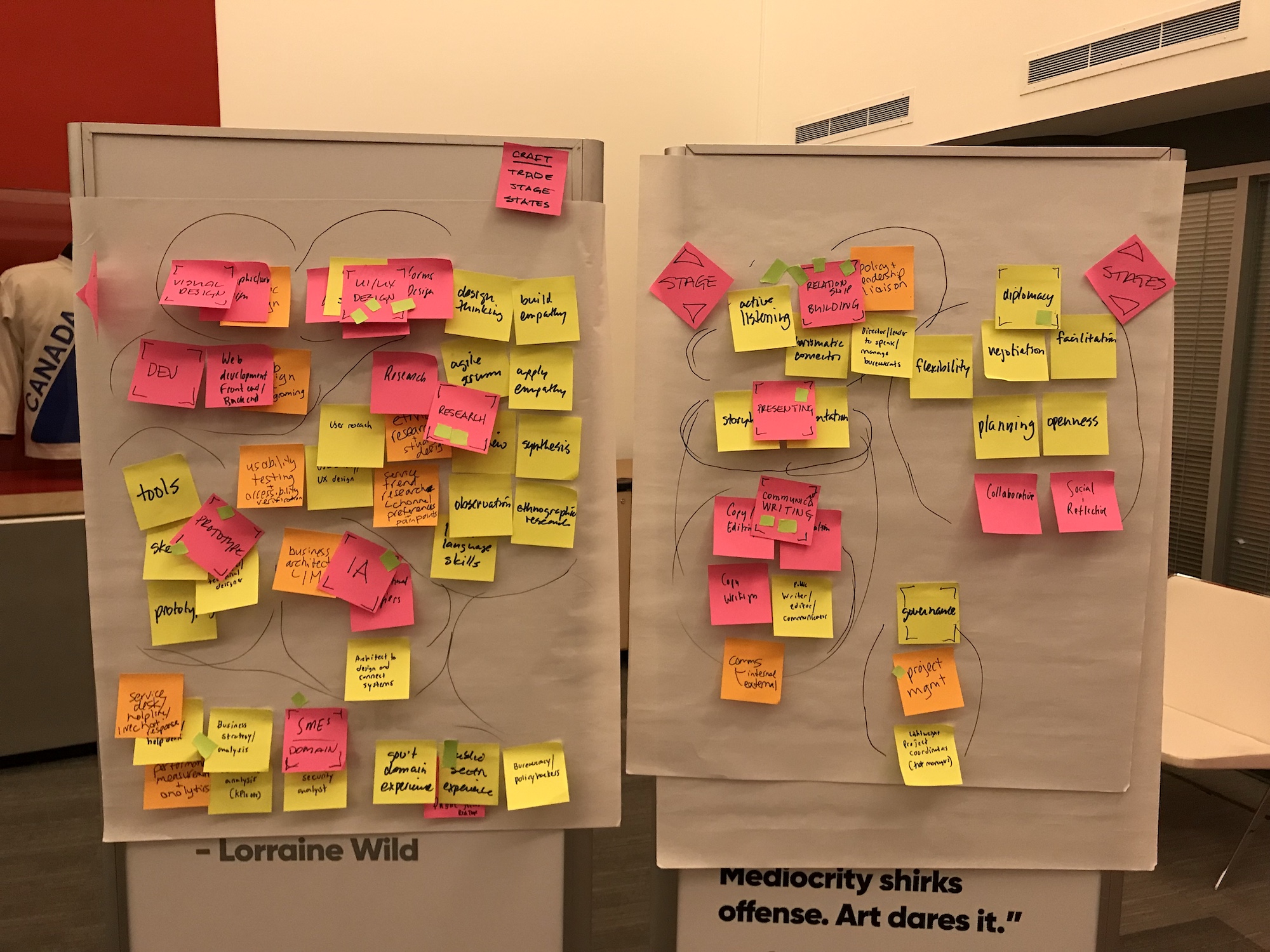
I worked with Claude AI to design an hour-long workshop and its slides, then ran it with six colleagues: three customer service reps, our customer success manager, our mobile developer and our founder.
Here's how it worked:
- A little homework first. The day before, I asked everyone to spend 20 minutes writing down 3–5 real client moments, one line each, starting with a verb: "Asked how to…", "Struggled to…", "Cancelled because…". They also listed the two or three types of customers they deal with most, one thing they were sure was true about our customers and one thing they'd always wondered. Each role got its own prompt too, like what slows new customers down in onboarding, where they get stuck, or why customers renew.
- Personas built from our own stories. In the workshop, we agreed on our top three customer types and split into pairs. Each pair told real stories and filled in a simple four-part card: who they are, what they want, what worries them and how we should show up for them.
- Known versus assumed. Every line on a card got a K (Known. What a client told us, or we saw it ourselves) or an A (Assumed. Our guess, to check with real customers). This made the gaps in what we knew easy to see.
- Bringing them to life with AI. We pasted a card and a few anonymized stories into Microsoft Copilot with a setup prompt: stay in character, answer in the first person, stick to the stories and say "I'm not sure" when they don't cover something. Then we sent follow-ups one at a time, asking for an honest reaction to a real onboarding email or support reply, what would build trust, what would make them leave and what they'd be too uncomfortable to ask us.
- Making the AI admit when it was guessing. The last message asked Copilot to step out of character and point out which of its answers were least supported by our stories. We also left "how we should show up" out of the prompt on purpose, so the persona would react as a customer instead of repeating our own assumptions back to us.
None of this needed code or a big budget. It mostly needed the same thing traditional persona work needs: good source material and someone willing to keep asking "is that actually true?"
What happened at the persona workshop
In 60 minutes, we went from a pile of one-line customer moments to six personas, each based on real stories and clear about what we knew and what we were only guessing.
Hearing a persona react, in character, to one of our own onboarding emails is a very different experience from reading a profile on a wall.
The old problem with personas was never the research. It was that they sat on a wall, or in a slide deck, frozen as soon as they were made. These personas were there in the room, ready to be asked.
How we have used the AI personas since
The workshop wasn't a one-off. I've gone back to these AI personas several times since to help me figure out UX improvements to our product's customer touchpoints.
The biggest example so far is a personalized PDF report that every customer receives each month.
This fall, alongside a summer of informal user research, I ran the report past our personas and was able to add some important feedback to our already long list of big and small UX improvements that I'd been maintaining.
That list then drove a full redesign: one report template for individuals and another template for family leaders who need to see their whole family's picture alongside their own.
What I like most about AI personas is the pace and availability. Instead of waiting weeks to schedule user interviews, I can test an idea in an afternoon, then take the best of it to real customers. That's the faster track the Microsoft team describes, and it's been a good fit for a small product team like ours.
What AI personas are not
AI personas aren't a replacement for talking to real people. They're only as good as the material behind them, and they can sound confident about things they don't know. I treat what they say as a strong hypothesis, not a finding.
A few things I'd pass on to other UX folks who've been in this game as long as I have:
- Ground AI personas in real evidence. Interviews, tickets, call notes. If you can't point to where an answer came from, be wary of it.
- Tell the persona it's okay not to know. A persona that admits a gap is far more useful than one that makes stuff up.
- Use AI personas to get to real users faster, not to avoid them. They're great for identifying and honing in on ideas before you spend your customers' time.
- Keep them fresh. Feed them any new research as you learn more, so they don't dry up like the old wall posters did.
AI personas are a new tool in the UX toolbelt
After more than 25 years of doing UX the traditional way, it's a little humbling to find something genuinely new to learn and that I just can’t brush away or roll my eyes towards. “Kids these days”…
Instead, this reminds me of my recent website redesign with Claude AI: I went in skeptical and came out with a different perspective.
I'm not going to stop doing interviews, gathering user feedback, running workshops or testing prototypes with real people. Those still matter, maybe more than ever. Everything that made a persona trustworthy back in 2008, like real research, clear goals and honest gaps, still applies.
AI just gives the persona a voice, and that's why AI personas have earned their spot right beside the methods I learned all those years ago. They help me ask better questions, move faster and bring the customer's voice into rooms where it used to be missing.
For a tool that honestly, started as a fun team-building experiment on a Friday, it's a pretty great result.